|

|
The convergence of portals and knowledge-management tools means
more data for more users
IMAGINE A COMPANY with talented, knowledgeable employees on its staff,
experienced management in the upper reaches, and skilled consultants on tap.
Every day these people write documents, exchange e-mail messages, and make
presentations. In other words, they generate knowledge, and knowledge is what
ultimately separates a company from the rest of the crowd. The problem is
that most of that knowledge and expertise is trapped, either in employees'
minds or in documents that may not be readily available. So how do you unlock
it?
At many companies, employees access corporate knowledge by searching through
locally stored e-mail messages or connecting to databases using various
applications. In a worst-case scenario, the process involves nothing more
than accidentally bumping into a co-worker in the hallway for a brief chat.
None of these approaches is very efficient: You can waste a lot of time
plowing through scattered databases, and you never know who you're going to
meet in the halls.
Corporate intranets and EIPs (enterprise information portals) have helped
many organizations get a grasp on their corporate information. Portals in
particular have attracted a lot of attention for their capability to
identify, refine, and deliver personalized data from various applications.
But EIPs rely mostly on CRM (customer relationship management) and ERP
(enterprise resource planning) applications for their data, meaning they
don't dig into unstructured data sources such as e-mail and spreadsheets.
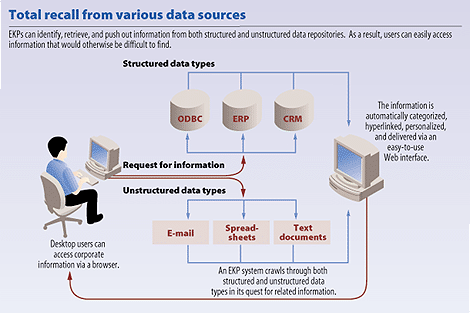
KM (knowledge management) tools can fill those voids. A KM system captures
both structured information, such as data gleaned from ERP and CRM databases,
and unstructured information that is not formally encoded, such as data
residing in text documents. By combining this KM technology with portal
technology, a new approach to accessing corporate expertise is born: the EKP
(enterprise knowledge portal).
Just like traditional portals, EKPs dynamically create user profiles, gather
data, and then push the information to users. Like KM systems, EKPs track all
forms of institutional knowledge, whether it is formally recorded or not.
With an EKP, users can access information beyond the data in relational
databases. Therefore, more knowledge can be shared by more people. Think of
an EKP as a kind of in-house research community.
As with all portals, personalization is a key feature of an EKP. Each user
gets a single sign-on to access the information resources he or she requires,
and the interface can be customized to fit individual needs.
Although a typical EKP includes all the parts of a standard EIP -- a portal
server that integrates with all the necessary data sources and a knowledge
engine that provides advanced searching capabilities -- EKPs are more than
just portals with knowledge-management features thrown on top.
Some packages, for example, offer tools that automatically build taxonomies
for searching. By analyzing users' actions, the tool can categorize, tag, and
hyperlink all content, thus sparing them from having to spend too much time
and effort on the job. In contrast, many KM tools require manual
categorization to build a taxonomy.
EKPs can also automatically deliver information by examining a user's
interaction and creating a personalized profile based on that information.
Some EKPs even scan users' desktops, watch their actions, and simultaneously
push related information to them in another window. Thus, an EKP could help
an employee write a report on distributed networks by searching for relevant
information while the user works. In a separate window in the browser
interface, the system could offer documents or links to sites on the subject,
plus information about who in the company is working on distributed networks.
What
lies beneath
Granted, this functionality comes at a price. As anyone who has ever
implemented a portal can imagine, it takes time to set up an EKP.
For starters, the process requires input from departments across the company,
including upper management, to help identify which data resources should be
included in the knowledge repository. Next, your IT staff must integrate the
EKP with back-end applications, a process which imposes hefty development
demands.
On the other hand, once the EKP is in place, very little ongoing maintenance
is required. EKPs automatically update information, and because all content
is scanned and categorized for knowledge sharing, no one has to intervene to
ensure that content is not lost.
EKPs aren't cheap, either. Expect to pay something in the neighborhood of $100,000
for a complete EKP implementation from a big-name player such as Lotus or
Open Text. There's no way around those costs, but if you want to simplify
your life, your best bet is to go with a company that offers a complete
portal solution. Autonomy's Portal-in-a-Box, for example, is a complete
knowledge portal with all the features of a traditional portal embedded
within a sophisticated reasoning engine for analyzing text and concepts from
various sources. The tool does all the categorizing, linking, personalizing,
and delivering necessary in an EKP.
Another product to keep an eye on is Lotus' up-and-coming EKP, K-station
(code-named Raven). Targeted to ship this month, K-station is positioned as a
portal with a heavy emphasis on collaboration between teams. Like Autonomy,
K-station promises to bring many tools into one integrated solution.
Eye
on the future
EKPs may not have much of a foothold in corporate America today, but that is
likely to change soon. By many accounts, KM is the next big thing, and portal
providers are already racing to build partnerships with KM vendors.
Because of their capability to deliver a substantial competitive advantage,
EKPs are a technology worth watching. If you have already invested in an
enterprise portal, you may want to simply augment your existing portal with a
KM engine. But if you're just entering the portal revolution, define your
needs, choose a vendor that fits, and try not to act too smug if your
employees storm your office to thank you.
Related
articles
Livelink
duo creates complete knowledge sharing portal
Enterprise knowledge portals wise up your business
Senior
Analyst Lori Mitchell knows all about the
inefficiencies of chatting with co-workers in the hallways. Contact her at
lori_mitchell@infoworld.com.
|
BOTTOM LINE
|
|

|
Enterprise knowledge portals 
BUSINESS
CASE
EKPs allow users to access information residing in unstructured data
repositories that typical portals do not search, such as text documents
and e-mail messages. By using EKPs to automatically collect and push this
data to users based on their individual processes, companies can extend
the reach of in-house knowledge throughout the enterprise.

TECHNOLOGY
CASE
An EKP requires relatively little ongoing maintenance. Users can access
information via a Web interface, thus minimizing workstation support. Web
development skills, however, are required to administer the back end.
|
|

|
|

|

PROS
+ Enables faster, more informed decision making
+ Improves interdepartmental communication

CONS
- Requires lengthy implementation
- Needs a hefty financial investment to implement
|
|
|
|
