|

|
|
|
|

|
Match content
to training method

1. Know your business problems, goals, and objectives.
2. Know the content being delivered and ask how it might be received.
3. Determine the length required for the class.
4. Find out the knowledge level of the student.
5. Determine how the student learns best: at his or her own pace or from
a classroom instructor.
|

|
|
|
|
|
|
Ensure that your employees are being given the most optimal training
by carefully determining the best method of delivery for the content
IN TODAY'S LABOR market, companies face high turnover rates, making it
difficult to retain and attract skilled employees. And recruiting processes
are often tedious and time-consuming, costing organizations a bundle. As
such, training programs have become important corporate perks not only for
employees, but for employers, too.
As a result, electronic learning or e-learning systems have caught on rapidly
during the past few years. E-learning programs provide a training system that
employees can log into from anywhere, at any time, a great advantage for
workers who are constantly on the go.
E-learning programs continue to evolve as they grow out of infancy. The
future direction of e-learning has been defined as "blended
learning," according to many company executives. E-learning system
providers, such as Centra
and Mentergy,
have found that their customers are blending multiple training practices to
provide a fuller, more beneficial training experience for their employees.
For example, a student may take a segment of a course through self-paced
e-learning and then attend a classroom session for the latter part of the
course.
Weighing
learning methods
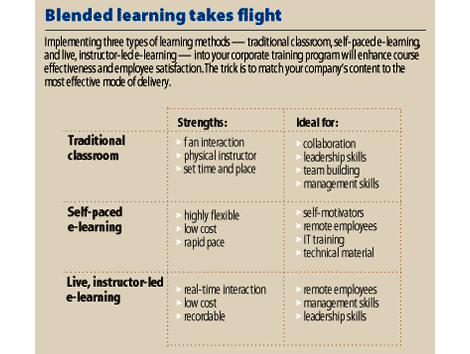
E-learning courses add value to traditional learning modes by offering
self-paced or live, instructor-led classes. Specifically, self-paced courses
can be taken at the student's leisure and are good for self-motivated
students. Typically these types of courses have been well-suited for IT
training and can be taken at anytime, anywhere, making them convenient for
busy workers as well as for globally dispersed employees. Companies such as
Digital Think and SmartForce provide a number of self-paced courses.
Live e-learning takes place in a virtual classroom at a scheduled time that
students commit to attending, just as they would a traditional class, minus
the travel. Students can collaborate, share information, and ask questions of
one another and of the instructor in real time.
Live e-learning is good for sharing information. Soft skills such as
management, leadership, or team building can be tackled in this environment.
However, this type of training works best if the class size is limited to 25
people to allow for optimal group interaction.
Not to be overlooked, traditional classroom training will always be an
effective means of learning. Classroom training is still unbeatable for the
amount of face-to-face interaction with both the instructor and classmates
that is necessary to learn certain management, leadership, and other highly
collaborative skills.
Blending
your training methods
Matching your company's content to the appropriate learning method is
critical for an optimum training program. Companies will want to consider the
curriculum method best-suited to their employees' needs. Begin your training
program by following these five steps.
1. Start with the business problem that needs to be solved and determine the
purpose of the course. For example, is the course designed to teach customer
satisfaction techniques? Increase sales?
2. Determine the best way to deliver the content. Will students be learning a
new behavior, new facts, how to build or put something together? Consider
these factors on a case-by-case basis and match them with the appropriate
learning medium.
3. Determine the length of the course and the amount of time students will
have to spend in each class. In-depth, lengthy courses may be broken into
segments, and some segments may be better suited for different delivery
methods.
4. The job function of the learner and the learner's background and
understanding of the material should influence which method is used. For
example, determine if all the material is necessary for all students, and if
the course can be modified or personalized for each person.
5. Discover how your employees learn best. Are they self-motivated; do they
enjoy interaction and collaboration? Generally, IT personnel are
self-motivated and able to learn via self-paced courses, but employees should
be able to choose the method that works best for them.
To keep up with the competition in a fast-changing world, employers need to
be able to offer training quickly and effectively to their employees.
Choosing the appropriate method for your company's curriculum can be just as
important as providing the training. Keep in mind the different training
options available and, above all, consult your employees to find out which
method they prefer.
Free-lance
writer Lori Mitchell covers e-learning
tools, productivity tools, and e-commerce. Send her your comments at
LoriMitch2001@yahoo.com.
|

|


